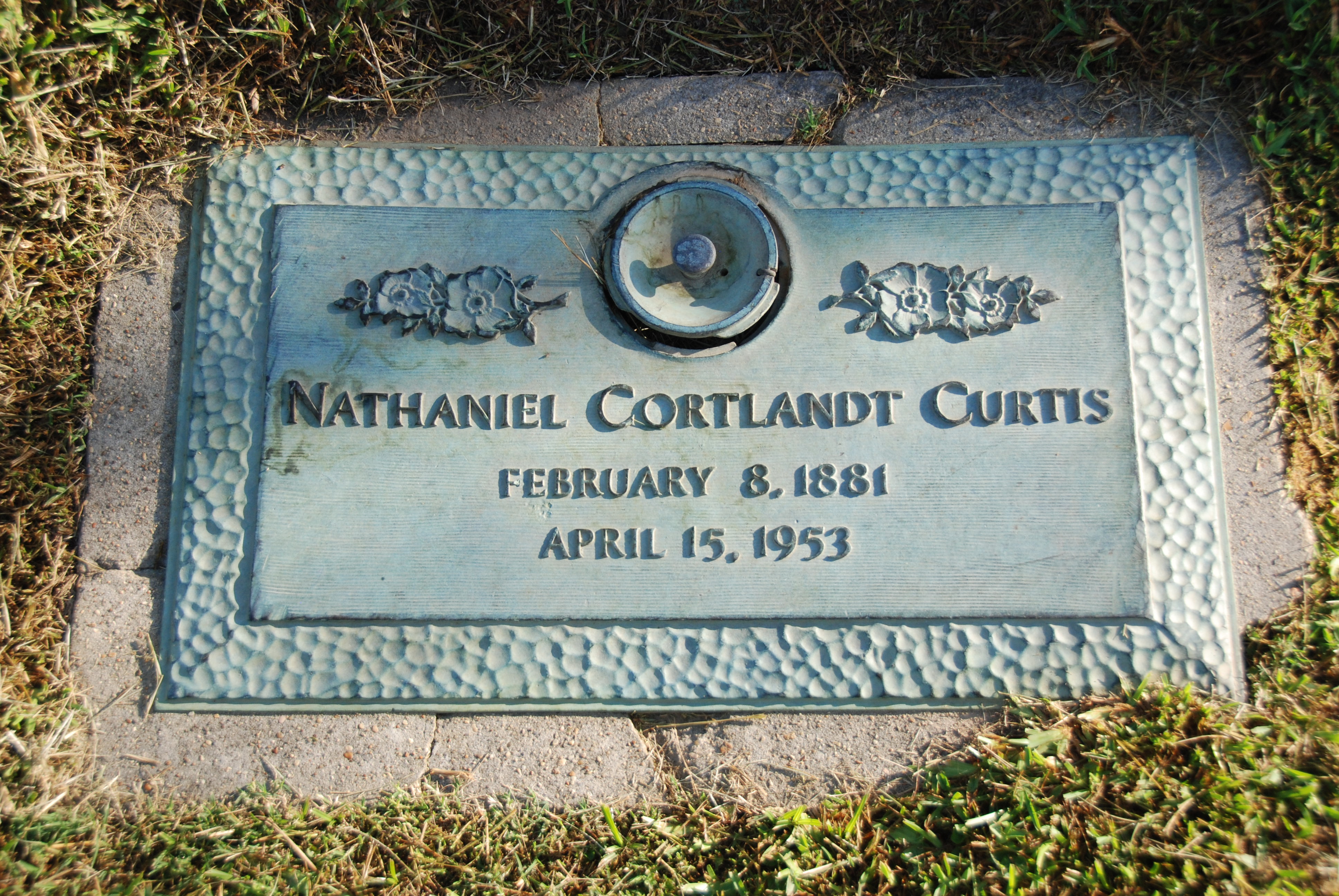
 Nathaniel Cortlandt Curtis Sr. (February 8, 1881 - April 15, 1953) was a prominent American architect, author, educator, and preservationist whose
scholarly and artistic contributions helped redefine the architectural identity of New Orleans.
Nathaniel Cortlandt Curtis Sr. (February 8, 1881 - April 15, 1953) was a prominent American architect, author, educator, and preservationist whose
scholarly and artistic contributions helped redefine the architectural identity of New Orleans.Queer Places:
Tulane University, 6823 St Charles Ave, New Orleans, LA 70118, United States
Garden Of Memories, 4900 Airline Dr, Metairie, LA 70001, United States
Nathaniel Cortlandt Curtis Sr. (February 8, 1881 - April 15, 1953) was a prominent American architect, author, educator, and preservationist whose
scholarly and artistic contributions helped redefine the architectural identity of New Orleans.
Born on February 8, 1881, in Southport, Brunswick County, North Carolina, to Dr. Walter Gilman Curtis and Margaret Johnston Coit Curtis, he grew up alongside his brothers, Walter Clarence and Howard Coit. Pursuing a career in the built environment, Curtis developed a deep expertise in both design execution and architectural theory. He married Elizabeth Lockhart Thach, who was born in Auburn, Alabama, in 1887. Together, they raised three children: Nellie Coit Curtis Page, Nathaniel Cortlandt Curtis Jr., and Charles Thach Curtis.
As an influential academic, Curtis served as the head of the Tulane University School of Architecture during its foundational early years. His pedagogical impact left a lasting legacy on generations of designers, and Tulane continues to honor his memory through a student prize awarded for outstanding essays on architectural theory and history. Beyond the classroom, Curtis worked as the principal designer and draftsman for the renowned New Orleans architectural firm of Moise H. Goldstein. Through his combined practical work and scholarly writings, he became a central figure in documenting, recording, and advocating for the historic structures of the region, earning a distinct reputation for his work surrounding historic Creole design traditions.
Curtis was among the pioneering architectural historians to recognize the significance of Creole architecture as a direct synthesis of social customs, local climate, and available resources rather than merely a collection of aging structures. In 1911, he produced a notable study and map labeled "Frenchtown 1911," reflecting the colloquial terminology for the French Quarter at the time. Through this research, he systematically cataloged key historic landmarks, including the French Opera House, Antoine’s Restaurant, the Morphy House (now Brennan’s), the French Market, the Pontalba Apartments, and several historic bank buildings. He grappled with the delicate tension between modernizing structural integrity and preserving the romantic, atmospheric aesthetic of decaying historic facades. He famously observed that an architect could not simply translate decaying antique beauty into pristine modern materials without risk of creating something inharmonious, a philosophy that positioned him as an early champion of historic preservation principles in the American South.
In addition to his academic and preservation accomplishments, Curtis established a profound family legacy in the discipline of architecture. His son, Nathaniel Cortlandt Curtis Jr., followed in his artistic and professional footsteps. Co-founding the firm Curtis and Davis in 1947 alongside Arthur Quentin Davis, Nathaniel Jr. drew constant inspiration from his father's foundational work. Curtis and Davis became the pivotal modernist design practice in New Orleans from the 1950s onward, growing into an internationally recognized firm responsible for iconic global landmarks and major regional structures like the Louisiana Superdome and the Rivergate.
Nathaniel Cortlandt Curtis Sr. passed away on April 15, 1953, in New Orleans, Louisiana, at the age of 72. He was laid to rest in Section K of the Garden of Memories cemetery in Metairie, Jefferson Parish, Louisiana, alongside his wife Elizabeth and children Nellie and Charles. Through his publications, his preservation mapping, his influence at Tulane University, and the architectural trajectory of his lineage, he remains a key figure in the historical and artistic narrative of Louisiana's built heritage.
In 1926 Pelican Bookshop Press, New Orleans, published "William Spratling and William Faulkner, Sherwood Anderson and Other Famous Creoles: A Gallery of Contemporary New Orleans", issued in 250 copies. The “Famous Creoles” (with ages in 1926) were
References:
 Dixie Bohemia: A French Quarter Circle in the 1920s (Walter Lynwood Fleming Lectures in Southern History) Paperback – September 8, 2014 by John Shelton Reed |
Other references:
Support this project
This website is a passion project researched, developed, and funded entirely by me. If you find the content valuable and would like to help support the ongoing research and hosting costs, any contribution is deeply appreciated.
Thank you for keeping this independent resource alive!
My books on Amazon: Elisa Rolle's books